


SIP Trunking
SIP trunking can revolutionize your business by letting businesses take a giant leap to upgrade their PBX to an internet-powered phone system.
It’s more reliable and lets you optimize all your business communications. From crisp voice calls to high-quality video, you’ll never risk your reputation with a poor calling experience.
Running your phone system through a SIP trunking is affordable, but it’s not necessarily for everyone. It replaces the need for physical lines. It also lets you easily add new phone lines or modify your phone service without disruptions or the need to buy new hardware.
Everyone from small businesses to large enterprises can benefit from SIP trunking. If you want to see why and how, this is the guide for you.
Let’s dive into:
- What is SIP Trunking?
- What is SIP Trunking Used For?
- How Does it Work? SIP Trunking Explained
- What is a Direct Inward Dialing Number (DID)?
- What Are the Benefits of SIP Trunking?
- SIP Trunking vs. PRI: Which One is Right For You?
- What is the Difference Between SIP and VoIP?
- How to Get Started With a SIP Trunking Service
What is SIP Trunking?
SIP, short for Session Initiation Protocol, is an application layer protocol that lets you run your phone system over an internet connection instead of traditional phone lines. Trunking refers to the backbone of phone lines used by multiple users that connects to a telephone network.
SIP Trunks provision Voice over Internet Protocol (VoIP) connectivity between an on-premise phone system and the public switched telephone network, also known as PSTN. For instance, an office might have an existing PBX for phone service. SIP trunks provide phone service for the entire office so they can reach the outside world.
It operates similar to HTTP, which is the very basis of browsing web pages on the internet. SIP was embraced by the open-source community and acted as a catalyst for online phone service. Also, SIP’s capabilities extend beyond phone service, into broader messaging functions.
Just like you’d get a traditional phone line subscription from a landline provider, SIP trunking is provided by a SIP provider.
An excellent SIP trunking service lets you use your existing PBX equipment to transition into an internet-powered telephone network.
And that’s not all: you can also use a SIP phone as part of your unified communications system. You can synchronize all your communication channels in real-time. This way, you’ll enhance productivity, collaboration, and efficiency across your company.’
What is SIP Trunking Used For?
The main role of SIP trunking is to replace PRI technology. PRI, or Primary Rate Interface, has been used for decades to deliver lines of voice and data using physical copper lines. Essentially, it’s a bundle of analog phone lines put together. PRI can be costly to maintain since the hardware is becoming outdated rather quickly.
With SIP trunking, this happens using VoIP technology. SIP also supports other data like instant messages and video conferencing.
SIP trunking is the right choice for anyone ready to move their business communication on a light budget.
This warrants a follow-up question: how will you know that your company is ready for SIP?
Here are some questions to consider:
- Are you currently paying for call capacity that you don’t need?
- Is it expensive to maintain all your equipment?
- Do your voice calls drop unexpectedly or need higher reliability overall?
- Do you have remote employees and/or employees that travel or relocate often?
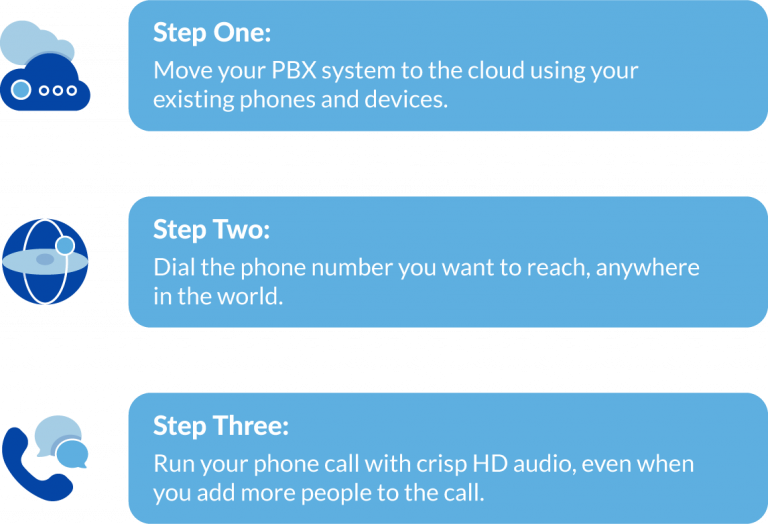
How Does SIP Trunking Work?
- Be on a voice call with one other person
- Have multiple people on a conference call
- Run video calls
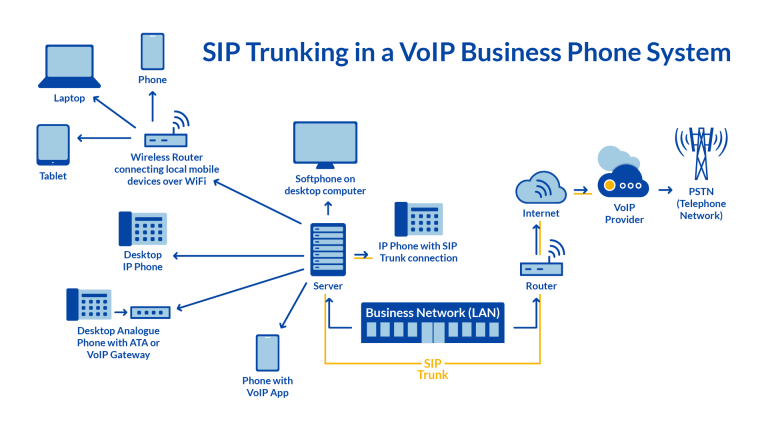
In the past, companies used ISDN circuits that needed to be physically installed on their premises. Now, instead of routing voice calls over copper lines in these circuits, SIP trunking sends them over data networks.
In other words, physical infrastructure is replaced with a virtual one.
- Internet connection
- SIP-compatible PBX (Private Branch Exchange) box, also called IP PBX
- VoIP phone, or VoIP adapters if you’ll use your existing traditional phones
- Network connection for your phones
What is a Direct Inward Dialing Number (DID)?
Want a cost-effective way to assign and manage a phone number for various people in your company?
Direct Inward Dialing (DID) numbers are your solution.
This service lets you have multiple phone numbers. Each of them rings a specific SIP phone in your company instead of going to a queue or an auto-attendant. The best part? You don’t need separate phone lines for each.
Your service provider will be the one to send an incoming call to your PBX over the SIP trunk. Then, your PBX will route the call to the right recipient based on the number that was dialed.

Purchasing your DID with a SIP trunk comes with cost savings because there are no additional infrastructure costs. If you get a DID from a phone company, you pay extra for hardware and maintenance.
You can use DIDs for specific purposes in your company, like customer service and sales. You can also use it for individual employees.
What Are the Benefits of SIP Trunking?
Still unsure of the advantages of this approach to your business communications? In this section, we’re diving into the benefits of SIP.
SIP connects a variety of devices to connect individuals and businesses locally and globally through voice, video, and text. It simplifies business communication systems and makes businesses technologically competitive. Here’s how.
1) Cost savings and efficiency
With a traditional phone line, you may be paying for extra lines you aren’t using. You might also incur high charges for long-distance and international calls. There’s also the cost of equipment maintenance.
With SIP trunking, you’ll experience simplified pricing, usually charged on a per-user basis. This comes with an extra benefit of predictability in your recurring expenses.
You get the choice between metered and unmetered SIP trunk plans. There’s a huge difference. Learn more about SIP Trunk Pricing.
2) Virtual presence
SIP creates a unified virtual presence. It allows individuals and businesses to choose when and how they would like to be available.
For example, if you’re in a business meeting, calls and messages can be forwarded to your assistant. If you’re on a business trip, they’re routed to a smartphone.
Thanks to SIP, you’ll have centralized communication. We all have multiple ways we communicate: multiple devices at home, just as many (or more) at work, texts, video chat…The list goes on. SIP grants a user one “address” for all these devices and applications.
As a result, your interactions remain frictionless, no matter where you are.
3) Space for growth and scalability
When you’re looking to grow your company, your business needs will change. Sometimes, they’ll change at a rapid pace.
You need your technology to grow with your business. With SIP trunking, you’ll combine your communications across channels and multiple offices into a single network.
Your call volume or the number of concurrent calls is likely to grow as your company grows. Technology shouldn’t stop you from doing things right.
No need for new IP infrastructure or waiting to speak to a customer service agent just to add new phone lines! With SIP trunking, you’ll be able to do all of that on your own, on-demand.
4) Reliable technology
Traditional telephony service can be disrupted due to phone failures, bad weather, or a damaged telephone pole.
Luckily, SIP trunking with VoIP boasts higher reliability. This means that you can keep using your phones even in case of failures. Calls can be routed to other lines, offices, or your mobile device.
No matter what happens in the background, you can keep your business going smoothly and interruption-free.
SIP Trunking vs. PRI: Which One is Right For You?
PRI is often compared to SIP trunking because they’re two ways to connect your phone system to the outside world.
Let’s look at the essential differences between SIP trunking and PRI (Primary Rate Interface).
1) PRI uses a traditional phone line to make phone calls
Each PRI circuit allows for up to 23 concurrent calls; for more than that, you’d need an additional circuit.
Because of that, it’s hard to scale when using PRI, and the costs of IT maintenance could skyrocket. PRI works best for companies with insufficient bandwidth for IP phones and limited access to a reliable fiber-optic network.
2) SIP trunking uses your internet connection to make phone calls
As long as your bandwidth is sufficient, you can keep adding phone lines and increasing your call volume.
Your service will remain of high quality, with redundancies in place in the case of an emergency.
In almost any case, SIP trunking will be your best choice. From saving money and enabling remote workers to international calling and easy scaling, the benefits of SIP trunking will make managing your communications a breeze.
What is the Difference Between SIP and VoIP?
SIP and VoIP both refer to internet telephony and are technically different. They’re often seen as two different options you can choose from.
However, you shouldn’t directly compare SIP to VoIP, and here’s why.
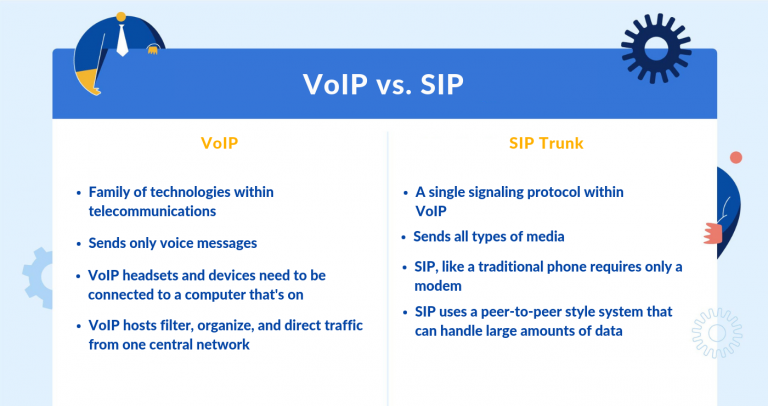
VoIP is quite a broad term that refers to any phone call made over the internet instead of the traditional, physical telephone line. VoIP stands for Voice over Internet Protocol.
SIP is one of those protocols—a specific protocol that facilitates VoIP. If VoIP refers to the type of phone calls you’re making, SIP is the protocol used for setting up that call.
In other words, the main difference between VoIP and SIP is their scope. VoIP isn’t a single technology, but a family of technologies. SIP sits under that VoIP umbrella.
How to Get Started With a SIP Trunking Service
Before SIP
Before SIP, enterprise communications had separate structures of voice and data communication. You probably know now that this can result in a comms and business continuity breakdown.
This old system cannot handle large volumes of calls, and customers may receive busy signals. All the while, the internet may be completely underutilized.
Businesses used multiple telecom carriers. They connected their PBX telephone network to multiple legacy carriers and lost money. These carriers charged money even when the lines were idle or busy, incurring toll charges and exorbitant long-distance charges.
After SIP
Now with complete interoperability through VoIP and SIP, communications sync with business operations. You can now route and record calls instantly, as well as manage emails.
Multimedia messaging can mean that on one side of the conversation, an individual can be texting and the other can be on a voice call.
Video conferencing, instant messaging, and instant data exchange can make communication reliable and speedy.
To make this your reality, you need to choose from a range of SIP trunking providers.
Here are some questions you’ll want to ask yourself when making this decision and reviewing features that SIP trunking providers are offering:
- Can I manage my phone system from an easy-to-use dashboard?
- How much will I reduce my costs?
- Will my phone service be disrupted in the transition?
- How long will it take to port my information over?
- Can I keep my current equipment or do I need to buy more?
- Can I easily add new phone lines?
With our plans, we give you all of the above control and power over your business phone service—and more.
We also have an award-winning customer service team to help you with anything you may need along the way.
Sounds good? Check out how you can power up your entire phone system with our cloud-based SIP trunks.